
Vatican museums are among the most popular in the world, with large art collections, including masterpieces from Michelangelo and Raphael, and to draw more than six million visitors each year.
But an exposure to Vatican City draws attention to bad reasons.
The Vatican Anima Mundi Ethnological Museum has thousands of Aboriginal artifacts that were taken from Canada communities by Catholic missionaries a century ago. Indigenous peoples have long called the artefacts to be repatriated and, in 2022, Pope Francis finally undertook to return them to Canada.
But after his death in April and the elections of Pope Leo XIV, Aboriginal leaders are now concerned about Pope Francis’ promise could die with him.
“He could simply be swept under the carpet,” said Gloria Bell, Canadian art historian, author and assistant professor at McGill University, who has a metis ancestry. “These goods have been stolen in indigenous communities.”
Indigenous wooden sculptures exhibited at the Vatican Anima Mundi Ethnological Museum.
Global News
In 1924, Pope Pius XI called Catholic missionaries from around the world to collect indigenous artifacts and bring them to the Vatican. The following year, the artefacts were exhibited as part of the Vatican Missionary Exhibition, a historic event that promoted residential schools and church missions around the world, which attracted around a million pilgrims and visitors.

Get national news
For news that has an impact on Canada and worldwide, register for the safeguarding of news alerts that are delivered to you directly when they occur.
The artifacts have since become a permanent collection at the Vatican. Global News visited the Amina Munda exhibition with Bell, who was visiting Rome to deliver conferences and extend her research on the origins of the artifacts.
The wide range of rare and invaluable artefacts includes a seal skin kayak and a wampum belt. Most items are currently kept in stock, but dozens are exposed. The Vatican exhibition calls them “gifts”.
“Calling a whole” gift “is just a false story,” said Bell.
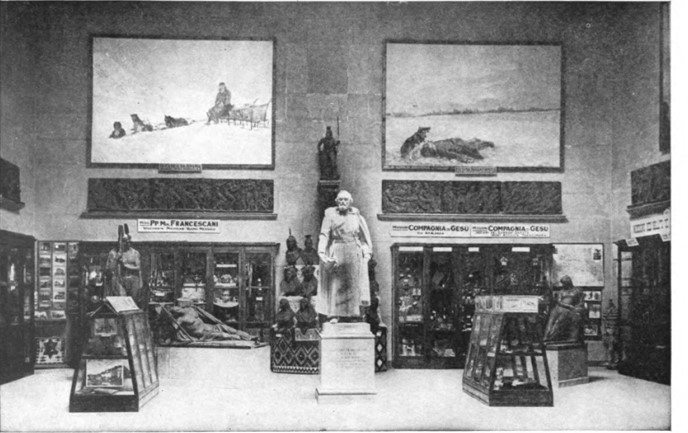
The Vatican Missionary Exhibition in 1925 promoted residential schools and missions of the Catholic Church around the world.
Supplied by Gloria Bell
She underlined an Aboriginal Australian activist, Anthony Martin Fernando, who held a man in a man on Saint-Pierre square during the Vatican Missionary Exhibition in 1925, distributing thousands of leaflets who denounced the way the artifacts had been stolen.
For his protest, Fernando was arrested and thrown into prison.
“Think of how everything was acquired by missionaries carrying out their genocidal work in indigenous communities in the 1920s, one of the most aggressive assimilation periods at the beginning of the 20th century, when these personal effects were stolen in indigenous communities,” said Bell.
“Aboriginal children were detained against their will in residential schools, then their documents were presented in this exhibition as the Pope’s” trophies “.”
The Inuvialit kayak, built a century ago in the Mackenzie delta region, is held in the Vatican museums.
Supplied by Rosanne Casimir


In 2022, a delegation of indigenous managers from Canada was invited in Rome to meet Pope Francis and discuss reconciliation efforts. During their visit, as a goodwill gesture, the Vatican officials showed private to the group some of the artefacts.
“Seeing these objects which were made by the hands of, in many cases, women of the generation of our great-great-great-grandmother, it was very moving, it was very deep,” said Victoria Parden, president of the Métis National Council, who was part of the delegation.
“You couldn’t help but feel that you are shooting in your heart that these items should be back at home. And they should be somewhere where our children and grandchildren and our communities could appreciate and contemplate them. ”
In 2022, Pope Francis officially apologized to residential schools and promised that the artifacts would have returned to their communities in Canada. Three years later, it is not clear if progress has been made on the file.
“There is a lot of rhetoric around truth and reconciliation, a lot of performativity around him, but there has not been any restitution to date,” said Bell.
The Canadian Art Historian Gloria Bell and the journalist of Global News, Jeff Semple, during a visit to the Anima Mundi Ethnological Museum of the Vatican, which houses thousands of Aboriginal artefacts.
Global News
The decision to return the artifacts will now rest with Pope Leo XIV newly elected. Global News asked the Canadian cardinals who participated in the conclave who elected him if he expects them to expect Pope Leo to hold the promise of his predecessor.
“The artifacts, the situation is something that I know in class. There is a reflection,” said Cardinal Gérald Lacroix, the Archbishop of Quebec. “Let’s get things wrong. But I’m sure (Pope Leo) will be interested in this.”
Purden, who returned to the Vatican city for Pope Francis’ funeral and again raised the problem at a meeting with Vatican officials, said that it was optimistic that the artifacts will be returned to their communities.
“What an important symbol of the reconciliation that will make them will be when we manage to achieve it,” she said.
& Copy 2025 Global News, A Division of Corus Entertainment Inc.


