
BBC News
 Reuters
The paramilitary fighters seem to have opened a new phase in the Civil War of Sudan after having been driven from the capital, in a decision that some experts described as a “shock and fear campaign”.
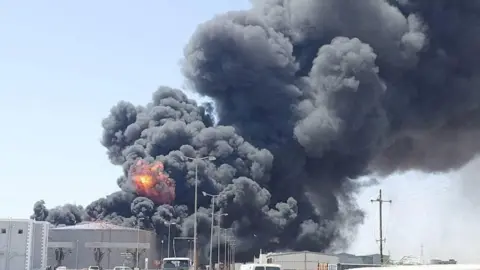
Only a few weeks after the army celebrated the recovery of Khartoum, its enemy The Rapid Support Forces (RSF) launched a series of unprecedented drone strikes in Port Sudan in the east of the country.
The attacks have led to the worsening of electricity failures, as well as residents of the city faced with water shortages.
“It is a level of projection of power in this region that we have not yet seen,” explains Alan Boswell, expert in Africa of the international crisis group.
“I think it increases the challenges a little,” he added.
The damage to the attacks on the capital of war and the humanitarian hub indicates that the RSF is determined and capable of continuing the struggle despite significant territorial losses.
And he showed the growth of the war of advanced drones in Africa.
Drones played an increasing role in the conflict, which entered its third year.
The war began as a power struggle between the Sudanese armed forces (SAF) and the RSF and attracted other Sudanese armed groups and foreign donors, plunging the country into what the UN calls the worst humanitarian crisis in the world.
Unmanned air vehicles (UAU) helped the army to advance earlier this year. And the RSF has intensified its own use of drones while it was expelled from central Sudan, in particular Khartoum, towards its traditional bastion in the west of the country.
In recent months, the paramilitaries had intensified drone strikes on critical civil infrastructure in the army controlled areas. This continued Wednesday evening with attacks against three power plants in the city of Omdurman, which is through the Nile of Khartoum. Damage caused widespread power outages in the capital region.
But it was the RSF’s sustained strikes on the Sudan port, so far as a safe refuge for government representatives, diplomats and humanitarian organizations, who underlined a change in strategy to a more emphasis on distance war, and aimed to demonstrate force.

 Reuters
“The RSF is trying to show that they do not need to reach Sudan from Port on the ground so that they can have an impact,” said Kholood Khair, a Sudanese political analyst.
The group tries to achieve a “narrative change” of “the triumphant SAF which took up Khartoum”, she says.
“He says to the Sudanese armed forces: ‘You can bring Khartoum back, but you can never govern it. You can have the Sudan port, but you will not be able to govern it, because we want to provoke a security crisis that war will not be ungovernable’ ‘… They want to show unequivocally that the war will not be ungovernable.”
The paramilitary group did not directly address drone attacks from Sudan Port. Rather, he repeated his assertion that the SAF is supported by Iran and accused the armed forces of targeting civil infrastructure and state institutions, qualifying the military strikes of Khartoum and the areas held by the RSF in the west and south of war crimes.
The two parties are accused of war crimes they have denied, but the RSF was distinguished on allegations of mass rape and genocide.
Change in his tactic may have been triggered by the need for the battlefield, but is possible due to technological advancement.
The RSF had previously used what are called suicide or home drones, small drones with useful explosive loads designed to crash on targets and can make coordinated attacks.
It seems to have deployed this method to Port Sudan, with the commander of the Military Zone of the Red Sea Mahjoub Bushra describing a swarm of 11 suicide Kamikaze drones during the first strike on a military air base.
He said that the army had killed them, but they turned out to be a tactical distraction to divert attention from a single strategic drone that managed to strike the base.
The brand of this drone is not clear. But the satellite images reported by Yale researchers and the Reuters news agency have shown advanced drones at an airport in southern Darfur since the start of the year.
Defense intelligence company Janes has determined them to be mostly sophisticated Chinese CH-95, capable of long-range strikes.
Jeremy Binnie, analyst in Africa and the Middle East at Jane’s, told the BBC that photos of what seems to be the remains of small suicide Kamikaze drones suggest that they are probably a different version of that of the RSF before, and could be better to penetrate the air defenses because of their form.
 Reuters
A regional observer suggested that the RSF had been able to violate the SAF anti-drone technology with signs of drones attached to drones, but warned that it was still not proven.
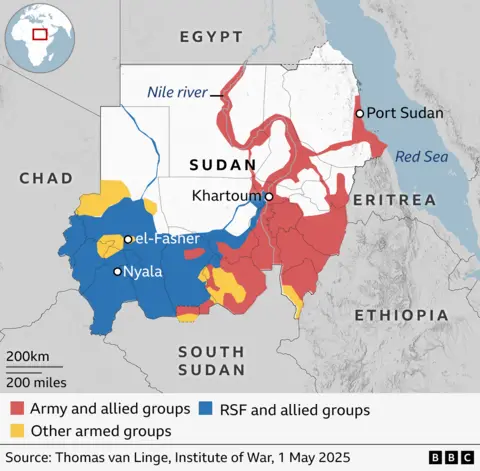
The southern Darfur airport in Nyala, the alleged capital and the military base of the rapid support forces, was bombed several times by the SAF, which destroyed an aircraft earlier this month.
Some experts see the bombardment of the RSF of the Sudan port at least in part as reprisals.
The climbing of the drone war has again highlighted the role of foreign actors in the civil conflict of Sudan.
“This is a war of technology,” explains Justin Lynch, Managing Director of Conflict Insights Group, an organization of analysis and data research.
“This is why foreign supporters are so important, because it is not as if the RSF made the weapons themselves. We give them that kind of thing.”
The army accused the United Arab Emirates (United Arab Emirates) of providing paramilitary fighters with drones and reducing diplomatic ties to Abu Dhabi due to attacks.
The water strongly rejected the loads. He has long denied reports of experts from the United Nations, American politicians and international organizations that he provides weapons to the RSF.
But Mr. Lynch says that the evidence is overwhelming.
He was the main author of a report funded by the American State Department at the end of last year which ended with “near the certainty” that the United Arab Emirates made weapons in the RSF by monitoring the imaging and the flight models of airlines previously involved to violate an embargo on the weapons of the UN.
He told the BBC that it would be surprising that the Emiratis did not help deliver the drones used in the attacks of Port Sudan.
He also determined with a similar quasi-certainty that the Iranians provided weapons to the SAF, and he helped to authentify the documents provided to the Washington Post which detail the sale of drones and warheads to the army by a Turkish defense company.
Iran has not responded to allegations. Turkish officials have denied participation.
The growing use of drones by both sides can redefine war, but it is RSF’s ability to strike strategic targets of hundreds of kilometers from its positions that have shaken the region.
More than a week of daily attacks against the Sudan port, the paramilitaries struck the country’s only International Labor Airport, a power plant, several fuel deposits and the air base, apparently trying to disturb the army supply lines.
The city is also the main port of entry for emergency supplies and the UN warned that this “major escalation” could further complicate aid operations in the country and lead to large -scale civilian victims.
“It was such a shock and adorable campaign that she not only amazed SAF, I think that it also amazed Egypt, Saudi Arabia, others who were behind SAF, and remake the whole war,” said Boswell, adding that he fills the meat of air power between the RSF and the army.
“The RSF is widely considered as a non-state actor,” he says “and normally, groups like this can bring together a lot of insurgent force. But the government with the Air Force is the one that always has aerial capacity, and that only puts all these old adages on the head.”
Development has triggered comparisons with the long -range drone war between Russia and Ukraine.
“These weapons have more precision, you no longer need an inhabited plane, and they are much more affordable than exploiting sophisticated jets,” said Binnie.
“This is part of a broader trend in technological proliferation where you can see what was once high -end capacities used in a civil war in sub -Saharan Africa.”
The Sudanese Ministry of Foreign Affairs has warned that attacks threaten regional security and the security of navigation in the Red Sea, calling on international actors to take “effective measures against the regional militia sponsor”, a reference to water.
Mr. Lynch estimates that only an agreement between the United Arab Emirates and the Sudanese army will end the war.
“This war is still evolving, still changes,” he says, “but you will see that it will continue for years and decades unless there are serious diplomatic measures to stop it.”
Find out more about the BBC Sudan Civil War:
 Getty Images / BBC


