
BBC Check
Israel is preparing a series of Gaza sites that could be used as a distribution centers for humanitarian aid in a new controversial plan, according to satellite images.
The Israeli government has suspended food and medicine deliveries in Gaza in March.
The ministers said that this decision, which was condemned by the leaders of the UN, Europe and the Middle East, aimed to put pressure on Hamas to release its remaining hostages. Israel also accused Hamas of having stolen from help – an allegation that the group denied.
The UN said that the blockade had caused serious shortages of food, drugs and fuel, and an assessment on Monday warned that the Gaza population of around 2.1 million people was at a “critical risk” in famine.
The United States has confirmed last week that it was preparing a new system to provide a series of hubs inside Gaza, which would be managed by private companies protected by security entrepreneurs and Israeli forces.
The images analyzed by the BBC Verify show that the land has already been cleaned, with new roads and staging areas built in several places in the south and the center of Gaza in recent weeks.
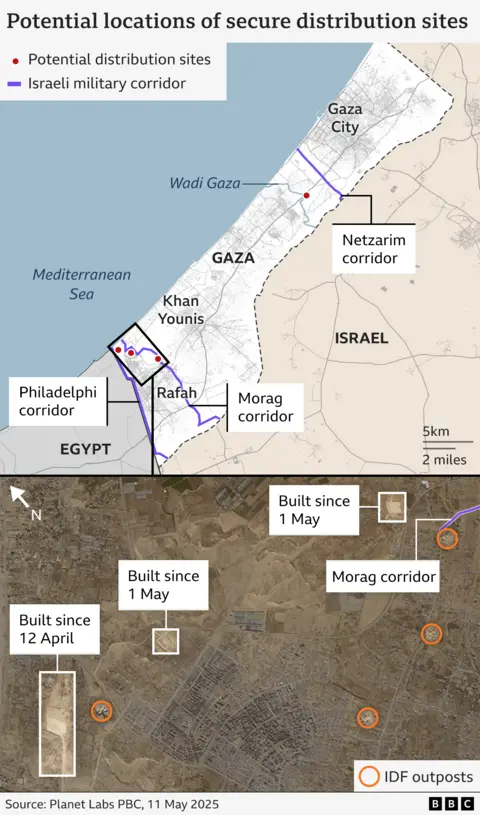
Israel has not publicly declared where the hubs are, but humanitarian sources – previously informed by Israeli officials – told the verified BBC that at least four centers will be built in the southern Gaza section and one further north near the Netzarim corridor, a strip of land controlled by the army which effectively divides the territory.
Gaza Humanitarian Foundation – An organization created to support the plan – initially declared that the food, water and hygiene kits would be provided to 1.2 million people, or less than 60% of the population.
On Wednesday, he announced that she would start operations before the end of May and seemed to ask Israel to authorize aid through normal channels until his distribution centers are fully operational. He also called for the construction of aid hubs in the north of Gaza, which is not envisaged in the original plan and which had led to criticism that people are forced to move south.
The United Nations agencies insisted that they will not cooperate with the plan – which is in accordance with a person previously approved by the Israeli government – claiming that it contradicts fundamental humanitarian principles.
A spokesperson for the United Nations Bureau for Humanitarian Affairs Coordination (OCHA) accused Israel of seeking to use “food and fuel as a lever effect, as part of a military strategy”.
“All the help would be channeled through a handful of militarized hubs,” Olga Cherevko told BBC Verify.
“This type of arrangement would reduce large Gaza areas – especially the most vulnerable, which cannot move easily, or are otherwise marginalized – with any help.”
Meanwhile, Bushra Khalidi from Oxfam described the new plan as a “farce”.
“No logistical solution will be addressed to the strategy of Israel for forced travel and the use of famine as a weapon of war. Lift the seat, open the passages and let us do our job.”
It is understood that the new proposed system has not yet had a final panel of the Israeli government.
‘Secure distribution sites’
The BBC checks the satellite imagery used to identify four potential sites based on available information limited on their locations.
The sites are similar in size, fit and design at existing outdoor distribution sites inside Gaza, as at Erez, Erez West and Kisupim. The largest site we have examined is larger – more comparable to the area inside Gaza in Kerem Shalom Crossing.
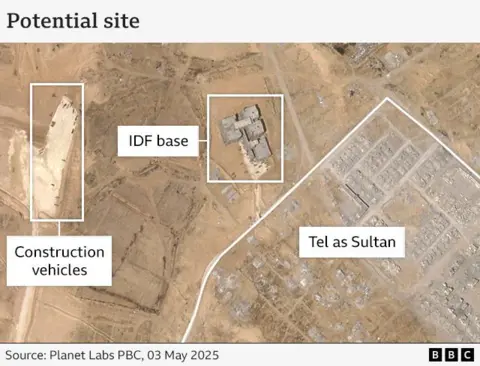
Our imagery analysis shows a significant development on one of the sites in the southwest Gaza, near the ruins of a village which is now a basis of the Israel Defense forces (FDI).
Satellite photos since early April show the construction of a road there and a large gathering area, surrounded by bermes – large defensive sand barriers or stacked earth – about 650 m (2,130 feet) from the border with Egypt.
A high resolution image captured on May 8 shows bulldozers and excavators working on a field of land covering approximately 20 acres (8 hectares). FDI armored vehicles are in a fortified building nearby.
A photo taken on the site, geolocated by BBC Verify, also shows that the lighting is installed on the perimeter.
Other images of May 11 and 12 show it, as well as three other sites, continues to develop. A site is about half a kilometer from a collection of eight United Nations warehouses and 280m from another large warehouse.

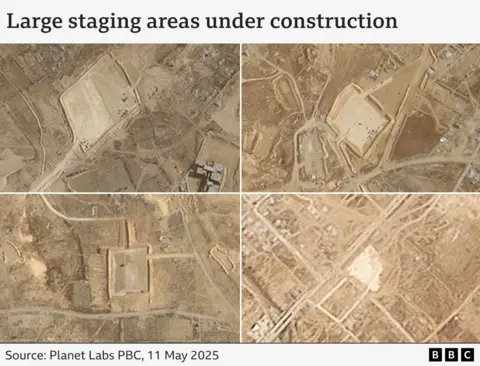
Stud Ray – A main analyst of images at McKenzie Intelligence – agreed that the sites were probably secure distribution centers. He noted that some of the installations are “near the operating bases of the FDIs which have linked to the FDI wishing to have some control over the sites”.
Analysts of another intelligence company, Maiar, said that the facilities seemed to be designed with separate entries so that the trucks move and go out, and with other gaps in the beams that would suit pedestrian entries.
The FDI did not comment on potential aid centers when it was approached by the BBC Verify, but said that its operations in Gaza had been carried out “in accordance with international law”. COGAT – The Israeli organization responsible for managing crossings in Gaza – did not respond to a request for comments.
Three of the four sites located by BBC Verify are south of the newly created Morag corridor of the IDF.
What is the Morag corridor?
It is an Israeli military zone that crosses the Gaza Strip and separates the southern cities of Khan Younis and Rafah.
Since the FDI established a security zone there in early April, a six-thousand (10 km) road was built covering two thirds of the Gaza width, bordered by defensive bearms and strewn with FDI landing.
This new route leads directly to one of the development sites visible in satellite imaging, and a preexisting road connects it to two others.
This whole area was subject to a land clearance extended by the FDI. BBC VERIFY geolocated videos and zone images through the Morag corridor, and to the south, filmed by Israeli forces, which show controlled demolitions using explosives and heavy machines, and in -depth destruction of buildings.
Humanitarian sources have said that Israeli briefings have indicated that aid would enter Gaza via Kerem Shalom Crossing.
Satellite imagery shows current construction work which is also taking place in recent months, with the apparent expansion of its storage zones, and new added roads.
Given that Israel has stopped new aid supplies in March, the UN reiterated that it had the obligation under international law to ensure that the basic needs of the population under its control are satisfied.
Israel insisted that he complies with international law and that he does not lack aid in Gaza.



