
Special correspondent
We hired through the warm light of the setting sun. There were villages and small towns where the lights arrived. It was a peaceful landscape where people were walking and led without constantly looking towards the sky.
We were on the suburbs of Amman when Safa’a Salha held her mobile phone so that I could read a message she had written.
“Oh my god,” writes this mother of Gaza, “Jordan is so beautiful.”
The evacuated came to the Jordanian border by road. I joined them there for the last part of the helicopter trip to Amman.
Safa’a spoke very little English, and in any case the noise of the helicopter made it impossible.
She showed me another message. “We used to see that [helicopter] Every day and it was bombing and killing. But today, the feeling is completely different. “”
Next to her was sitting, her 16 year old son Youssef who showed me the scar on her head of her last operation. He smiled and wanted to speak, not Gaza but ordinary things. How he was excited by the helicopter, how he loved football. Youssef said he was very happy and gave me a fist.
Beside him, Sama Awad, nine, frail and frightened, holding his mother’s hand, Isra. Sama has a brain tumor and will undergo surgery in Amman.
“I hope she can get the best treatment here,” said Isra, when we were on the ground and the noise of the engines was up.
I asked a question to those who answered me several times looking at images, but not face to face by someone who had just left.
What does Gaza look like now?
“It’s horrible. It is impossible to describe. Horrible at so many levels. But people are just trying to continue living,” replied Isra.
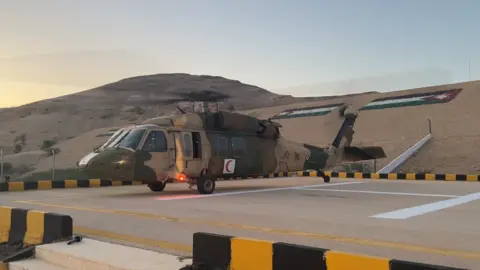
Four sick children were evacuated to Jordan with twelve parents and tutors. They left Gaza by ambulance on Wednesday morning and traveled through Israel without stopping until they reach the border crossing.
The plan to evacuate the children was revealed for the first time at a meeting between US President Donald Trump and King Jordan Hussein in February.
Jordan’s declared objective is to bring 2,000 sick children to the kingdom for treatment. Until now, only 33 have been evacuated to Jordan, each traveling with a parent or a tutor.
Jordanian sources say that Israel has delayed and imposed restrictions – as well as the resumption of war – hampered the evacuation process. Malades have also been evacuated to other countries via Israel.
We have put Jordanian concerns to the Israeli government responsible – COGAT (coordinator of government activities in the territories) – which has told us that in the start of the year, and especially in recent weeks, there has been a significant increase in the number of Gazans evacuated by Israel for medical care abroad “.
Cogat said thousands of patients and escorts had gone to countries, including Jordan, the United Arab Emirates, the United States and others. The press release indicates that “the hostilities underway in the Gaza Strip pose a challenge to the implementation of these evacuation operations”.
Israel broke the last cease-fire in March, launching a wave of attacks against what he said is Hamas positions.
Gaza remains a claustrophobic area of hunger and death for its residents. Those who go out for medical treatment are the exception.
According to the UN, the population of 2.1 million inhabitants faces the risk of famine. The organization’s humanitarian affairs chief Tom Fletcher called on the UN Security Council to act to “prevent the genocide” in Gaza.
These are strong words for a man trained in sober traditions of the British Foreign Office and who was ambassador and main government advisor.
Israeli blocking prevents essential aid supplies from reaching the population. That with the continuous bombing explains the description by Isra Abu Jame of a horrible place beyond words.
Children who arrived in Jordan on Wednesday from Gaza will join a small community of other young people injured and sick in various Amman hospitals.
Since January, we have followed the case of Habiba Al -Akari, who came with his mother Rana in the hope that the doctors could save three members infected with the gangrene – two arms and one leg.
But infection – caused by a rare skin condition – had gone too far. Habiba suffered a triple amputation.

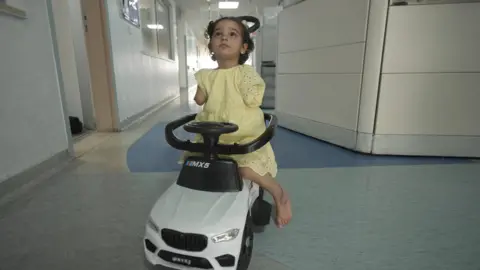
When I met Habiba and Rana again this week, the little girl used the toes of her remaining foot to scroll and play children’s games on her mother’s phone. She blew kisses with the stump of her arm. He was a very different child of the frightened girl I met during the evacuation of the helicopter five months ago.
“He’s a strong person,” said Rana. Habiba will be equipped with prosthetic members. She is already determined to walk, asking her mother to hold under her armpits while she jumps.
One day, Rana hopes that she will bring Habiba back to Gaza. The mother and the child are safe and well maintained in Amman, but their whole world, their family and her neighbors are back in ruins. Habiba’s health concerns make Rana reluctant to consider returning soon.
“We have no house. If we want to go back where will we go? We will return to a tent full of sand …[but] I really want to come back. Gaza is magnificent, despite everything that happened. For me, Gaza will always be the most precious place in this whole earth. “”
They will come back. But in war or peace? No one knows.
With additional reports from Alice Doyard, Suha Kawar, Nik Millard and Malaak Khassouneh.


