
 EPA
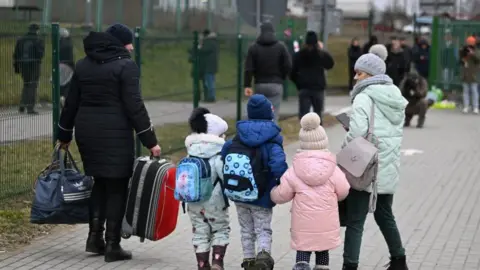
EPASvitlana says her daughter loved her school in Poland.
“Even when we moved to another region, she did not want to change schools,” said the 31 -year -old Ukrainian mother. “She loved it so much. There was no bullying.”
Now she says that the atmosphere at school – and in Poland overall – has changed.
“Two weeks ago, she came home and said” a boy said to me today: “Go back to Ukraine”. “Svitlana was amazed.
It is one of the dozens of Ukrainians living in Poland who told the BBC that anti-Ukrainian feeling had increased considerably in recent months.
Many have described abuse public transport, intimidation in schools and xenophobic documents online.
A polarizing election campaign added to the tension, the first voting round taking place on Sunday.

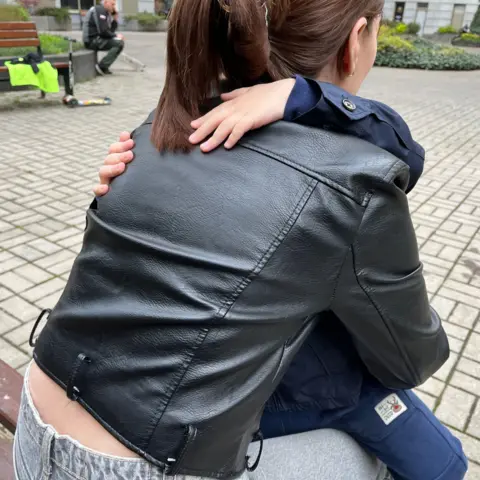
The day after the daughter of Svitlana, the daughter of Svitlana was invited to return to Ukraine, the abuses became even worse.
“The girls of the class above began to complain about his speaking Ukrainian. Then they pretended to fall on the ground, shouting” missile! Go down! “And laughing,” said Svitlana. “She came home crying.”
A Russian missile had struck the hometown of Svitlana in Ukraine a few days before, killing dozens of civilians, including children. Her daughter was traumatized.
Svitlana – his real name did not want to be identified as her fear reprisals. She showed us screenshots of messages with the school staff where she complains about the processing of her daughter.
She said that she had noticed that the attitudes also changed to the Ukrainians in other places: “At work, many people say that the Ukrainians come here and behave badly. And my Ukrainian friends say they want to go home because the Poles do not accept us. It’s scary to live here now.”
According to government statistics, at least 2.5 million Ukrainians live in Poland, representing almost 7% of the total population in Poland.
When Ukraine’s large -scale invasion began in February 2022, there was a sampling of compassion of the poles. “It was incredible. Every day, people called, asking,” How can we help? “” Said activist Natalia Panchenko, head of the “Stand with Ukraine” foundation, based in Warsaw.
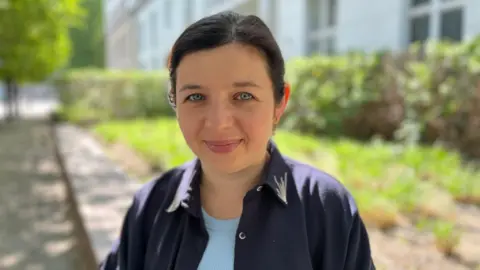
“Some of them organized humanitarian convoys or brought the refugees here. They gave their homes, their food, everything they have – and their hearts too.”
Three years later, Natalia says that she thinks that the majority of posts still support Ukraine. But some do not – and its organization noticed an increase in online anti -Ukrainian abuses that started several months ago.
“Then it started to come in real life,” she said. “Recently, we have more and more these types of situations … xenophobic [abuse] people working in stores or hotels simply because they speak with a Ukrainian accent. “”
Natalia says that many Ukrainian refugees are traumatized. “These groups of women and children are in Poland because of the war, very often their loved ones are on the front line, in captivity or in the dead … and it is the group of targeted people.”
Research suggests that Poland’s public opinion on Ukrainians aggravates. According to a March 2025 survey by the CBOS Center respected, only 50% of posts are favorable to the acceptance of Ukrainian refugees, a drop in seven percentage points in four months. Two years ago, the figure was 81%.
About a million Ukrainians are officially recorded as arriving after the start of the large -scale invasion. Poland spends 4.2% of its GDP on Ukrainian refugees.
 EPA
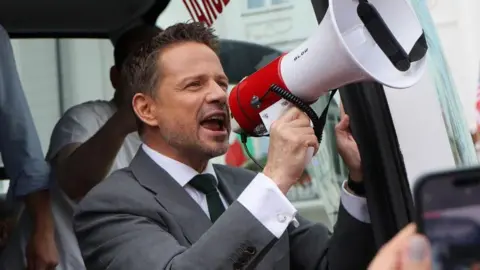
EPAUkraine has become a political question with hot buttons in the crucial election campaign of Poland.
The far-right populist Slawomir Mentzen, currently in third place, is virulently anti-Ukrainian and supports an “agreement” with the Vladimir Putin of Russia.
Second place is the curator Karol Nawrocki, who opposes the members of the EU and NATO to Ukraine and the financial aid for refugees, but supports the war effort.
The most pro-Ukraine candidate is the first Rafal Trzaskowski runner in the Coalition of Prime Minister Donald Tusk, although even promised him a reduction in social protection for Ukrainians.
Trzaskowski refrained from reaching his pro-Ukrainian references to attract centrist voting during the elections, explains political analyst Marcin Zaborowski.
“He responds to the change in public attitudes. The initial enthusiasm to support war victims is to disappear, negative feelings take over and this is not an entirely comfortable problem for him.”
Another far -right candidate, Grzegorz Braun, is the subject of an investigation by the police for having demolished a Ukrainian flag of a building in the town hall during an electoral rally in April. Braun, who questions only 3%, regularly fulminated against what he calls “Poland Ukraination”.
Last week, the Polish government warned against an “unprecedented attempt” of Russia to interfere in the Polish elections by broadcasting “false information among Polish online citizens”. Moscow denies all the allegations of election interference.
Michal Marek, who directs an NGO that monitors disinformation and propaganda in Poland, offers some examples of anti-Ukraine equipment broadcast on social networks.
“The main stories are that the Ukrainians fly money in the Polish budget, that the Ukrainians do not respect us, that they want to steal us and kill us and are responsible for the war,” he said.
“This information starts in the Russian telegram channels, and after that, we see the same photos and the same text that has just been translated by Google Translate. And they push [the material] in the Polish infosphere. “”
Mr. Marek links such a disinformation directly to the increase in anti-Ukraine feeling in Poland, and says that an increasing number of poles are influenced by propaganda.
“But we will only see the effect after the elections – what a percentage of poles want to vote for openly pro -Russian candidates.”


